
In an uncertain funding landscape, it’s helpful to develop a general strategy for a broader range of fellowship applications. This may include finding fellowships you had not previously considered, matching your skills and research goals to the solicitation materials, and crafting an application package that positions you as a qualified scientist and engineer while conveying a consistent “personal brand.” Putting together a fellowship application package can also be a time of deep reflection, helping to clarify your motivations and aspirations, whether they be personal or research based. Admittedly, all of this can be overwhelming if it’s a fellowship you are less familiar with or if you feel uncertain about how to convey the value of your experiences, skills, and goals. To jumpstart the brainstorming and writing process, we’ve developed three “pillars” of fellowship application writing.
Pillar 1: Decide if you’re a match
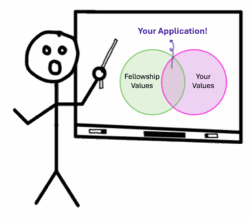
It may seem obvious, but the best place to start is reviewing the eligibility and application requirements for a fellowship, as well as any online media that reflects a program’s mission and goals in granting fellowships. Check out biographies of successful applicants, spotlights on funded research, mission statements, etc. As you review these materials, reflect on what the program is looking for in candidates, even if it goes unstated. Are they interested in technologies that target a specific global challenge? Are they interested in innovations for industrial or business applications? Do they seek to sponsor fundamental science? How did successful candidates demonstrate their passion or qualifications? As you gather answers to these questions, start envisioning how your goals align with the call. Scrutinizing these things through the lens of a fellowship application can help you clarify your own research motivations and elements of your background that build the foundation of your future work.
Pillar 2: Identify a memorable personal brand to carry your statements
Once you understand what qualities make for a successful applicant, you can start to brainstorm what about you aligns with the mission of each fellowship. This personal brand shows how you are a unique and qualified match for their program. It will also make you more memorable to reviewers evaluating dozens of applications.
While this may seem silly, you should think of your personal brand as the “secret sauce” that sets you apart from other people. It should answer questions about your distinctive background, motivations for your work, and your future goals. Consider different celebrities and their personal brands. For example, looking at Hank Green, his brand revolves around his enthusiasm for making science accessible because of his belief that “science is the best tool we have to solve the biggest problems.”
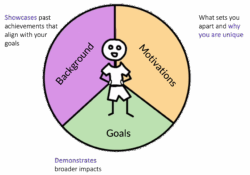
How to show your brand depends on the statement. Your personal statements is a chance for the fellowship committee to get to know how you are personally qualified for an application. Here you will showcase your experiences, your short-term and long-term goals, and how those experiences and goals qualify you for the Fellowship. If you consider what qualities they are looking for (in pillar 1!), this information can help you tailor what experiences you discuss. For example, if a program is looking for someone who is motivated by their community, it could be a good idea to showcase experiences such as volunteerism and teaching assistantships. You can find more resources and examples of personal brand in personal statements from other Communication Lab resources including this article on NSF GRFP personal statements, graduate personal statements, and this overview from the NSE Comm Lab on qualified match.
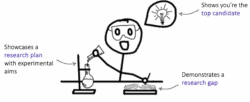
The research statement is where you demonstrate that you can identify a research gap (unsolved challenge or open question in your field), develop a plan to solve that challenge, and show that you are the best person to do this work (an extension of your personal brand!). Think about the bigger issue or gap you are addressing with the research plan. Are you trying to figure out a way that a specific cancer propagates within the body because of a personal experience with cancer? Are you focused on plastics recycling because you come from a community greatly affected by pollution? Are you focused on expanding computational efforts in a specific field because you are motivated by increasing access to technology amongst all populations? Whether the research topic you cover is fundamental or not, typically you have some motivations as to why you entered your field of work and continue to address these issues. Make sure that your motivations in both your personal and research statements make sense together. You can find more details on writing a research proposal from the Communication Lab including the NSF GRFP research proposal and NDSEG fellowship program.
By thinking about your personal brand first, it will inform which experiences and skills you decide to showcase in your different statements. And by having a coherent personal brand in personal and research statements, you will become a memorable candidate and foster trust in the minds of your readers that you are the most qualified person for the problem you are trying to solve.
Pillar 3: Solicit feedback
As with any written deliverable, getting feedback on your statements is crucial to ensure the ideas and connections that are natural to you translate to your audience. Generally, you should seek feedback from people across the following categories:
- Your PI or direct mentor
- Other graduate students and post-docs that work in your research area
- People unfamiliar with your research field (Comm Lab fellows!)

As specialists in your field, a PI or direct mentor can help you assess if your research “gap” is appropriately sized and targeted. They can also give you feedback on how well your aims or objectives relate to your broader research goals, personal motivations, or professional goals. Similarly, graduate students or post-docs that work in your research area can help assess the linearity of your scientific ideas while also helping to catch needless jargon that may be distracting.
Consider asking for feedback about specific aspects of your application to avoid feedback that may not be constructive. It could be good to ask several people within your research lab and/or PI to review your aims and make sure their order, level of detail, and experimental designs make sense. However, for checking that one of the reviewers understands jargon, it is vital to ask others who are unfamiliar with your research field, such as your friends or Comm Lab fellows. Be sure to ask for this feedback well ahead of your application deadline; give yourself time to review feedback, implement changes, and iterate without the stress of a looming deadline. Finally, making an appointment with the ChemE Comm Lab is an effective tool for working through communication challenges, whether you are in the brainstorming and outlining phase or putting the finishing touches on your application.

Megan Herrington is a graduate student in the Smith Lab and a ChemE Communication Fellow.

Erin Sturd is a graduate student in the Smith Lab and a ChemE Communication Fellow.