
Technical workshops offer a venue for people with similar interests to convene and present recent/developing results, run tutorial sessions, and determine important directions of research for their field. Typically shorter and more specialized than conferences, workshops are often organized by small teams of researchers and provide an excellent opportunity to expand your network and discuss ideas with people working on problems that have overlap with yours. I’ve found that there is no better way to ensure that a workshop will cater to your interests than by organizing one yourself. While it does take some work, organizing a workshop is a manageable undertaking for a small team of dedicated students. This blog is intended to serve as a how-to guide for first-time workshop organizers based on my experience as the lead organizer for the first edition of the Workshop on Formal Verification of Control Systems with Neural Network Components (VNNCS), which was held alongside the American Control Conference in July 2025. A high-level guide is also provided in Figure 1. where each element is discussed in greater detail in the following sections.
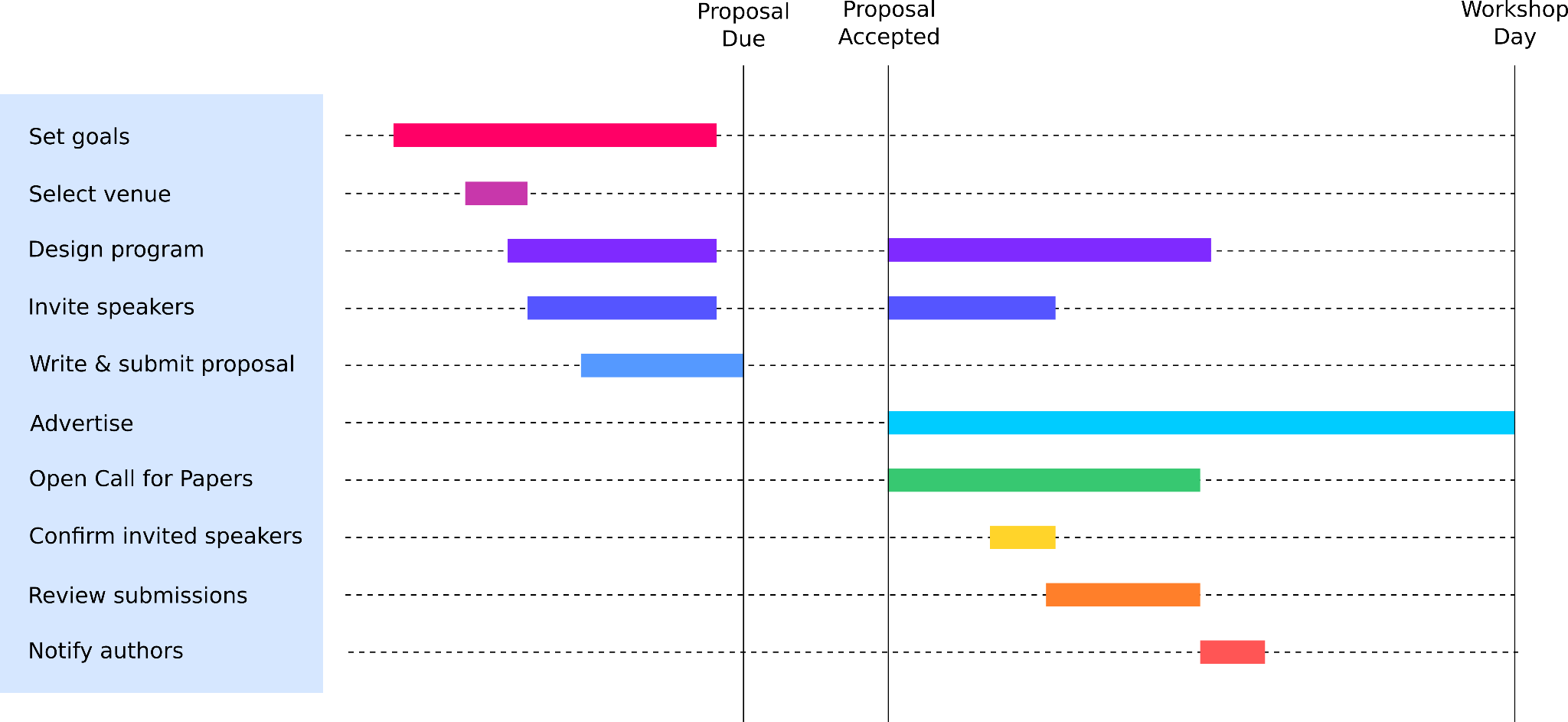
Figure 1. Gantt chart outlining key steps in planning a workshop.
Step 1: Decide to run a workshop
Unsurprisingly, the first step in running a workshop is deciding to do so. I have not heard of any PhD programs, professorships, or industry positions where one is required to run a workshop, so why put in the effort? I think there are many good reasons. First, workshops are a great way to reinforce community within your area of research. Large conferences can feel vast and impersonal, but a small workshop can help you put faces to names of researchers you follow, helping to establish a sense of community and foster collaboration. As the organizer of a workshop, you will be at the forefront of this community building effort and naturally have the opportunity to connect with many of the attendees. Moreover, organizing a workshop offers a great way to purposefully expand your professional network. If you choose to invite speakers, you will have a say on who is invited and can select people who you’d be interested in hearing from and meeting with.
In addition to these career- and network-building motivations, strong workshops often have a theme centered around some specific technical objective. Thus, as part of your decision to run a workshop and through the initial planning phase, it is a good idea to think of specific goals and outcomes you would like the workshop to accomplish. Examples of such objectives could include:
- Investigating the gap between academic foci and industry needs
- Identify the key open questions for your field
- Provide a lower-stakes venue for junior researchers and presentation of early-stage work, negative results, and position papers
It’s helpful to have an idea of these goals during the initial planning phase, but keep in mind that they may need adjustment as you solidify your venue and program.
Step 2: Choose a venue
Workshops are often held alongside larger conferences. This offers a distinct advantage because it helps to facilitate many of the logistics: physical location, tech support, advertising through official conference media, etc. It additionally allows you to capitalize on existing travel plans — it’s easier to get good attendance if people are already in the area and do not need to travel solely for your workshop. If you do decide to hold your workshop alongside a conference, keep an eye out for their call for proposals (CFP). If the conference is supporting workshops, you will likely have to submit a workshop proposal, which will be discussed later. For the rest of this blog, I’ll assume you decide to organize alongside a conference, but keep in mind that hosting a workshop separately, e.g., at your university, is another option to consider. It just may take more work to cover the logistics.
Step 3: Formulate a program
Once you’ve decided where to hold your workshop, it is time to design the program. There are several possible elements you may consider incorporating into your workshop, including but not limited to: invited speaker presentations, submitted paper presentations/posters, panel sessions, and tutorial sessions. Ideally, these are designed with interactive components, such as allotted time for audience Q&A and small group discussions, to encourage richer participation. You should also include time to lay out the goals of the workshop and introduce the workshop organizers. Consider the main conference’s CFP and if there are any specific focuses suggested by the conference, e.g., industry focus, tutorial value. Also make sure to program time for coffee breaks, lunch, and possible buffer time in case a speaker’s talk goes long.
Step 4: Invite Speakers
If you choose to invite speakers, it is important to start sending out invitations as soon as possible to give them time to plan travel. Confirming speakers early can also help when writing your workshop proposal: it shows that your workshop topic is important enough for experts in your field to commit to speaking and also indicates an extra level of effort and preparedness (for context, I recently had a workshop proposal get rejected, in part because not enough invited speakers were confirmed).
When designing the program and deciding which speakers to invite, consider any focus suggested by the main conference’s CFP. An example email to an invited speaker is provided below, but keep in mind that you may want to modify it, especially if you are familiar with the person.
Dear [invited speaker],
I hope this message finds you well. I am writing on behalf of my co-organizers regarding a workshop proposal we are submitting to [main conference name] tentatively scheduled for [workshop date].
Workshop Title: [title]
Workshop Summary: [brief description of your workshop, no more than 100 words]
Given your work on [relevant work], we believe you would be an excellent fit for this workshop and would bring a valuable perspective on [interesting topic].
Please let me know if you would be willing to speak if the workshop is accepted. We would be happy to follow up with additional details on the format and logistics.
Best regards,
[your name] (on behalf of the [workshop acronym] organizers)
Step 5: Submit the Workshop Proposal
Now that you have an idea for your program and possible invited speakers, you’re ready to submit a workshop proposal. Before beginning, check the main conference’s CFP for any recommended structure or specific sections to include. Workshop proposals are typically a few pages long and include sections on the following elements:
- Abstract
- Present high-level summary of the workshop
- Include technical focus, program elements, workshop goals, etc.
- Objectives and Expected Outcomes
- Outline goals of the workshop
- List relevant technical topics that may be discussed
- Invited Speakers
- List speakers that you’ve tentatively confirmed, if any, with a short bio or description of their work
- Discuss plans to invite more speakers
- Duration of the workshop and proposed program
- Provide a time table of program
- State whether your workshop is half-day or full-day (often requested by a CFPs)
- Participation, Solicitation, and Dissemination
- Describe your plan to advertise your workshop (as I’ll discuss later)
- If your workshop will have submitted papers, describe how this will be handled
- Diversity and Inclusion
- Discuss how your workshop encourages a diverse set of voices (technically, geographically, career stage, etc.,)
- Organizers
- List organizers, affiliations, short bios
Once you and your co-organizers are happy with the proposal, submit it through the conference’s submissions page.
Step 6: Advertisement and Managing Submitted Papers
Once your workshop proposal is accepted, there are several things that should be done as soon as possible. First, you should create a website for your workshop that contains basic information related to important dates, registration, invited speaker talks, organizers, the program, and instructions for submitted papers (if you choose to have them). Here is the website I designed for VNNCS. Your website should be included in all of your communications with speakers and participants to ensure they have complete information, and may be used by the main conference website to advertise your workshop.
If you decide to host submitted paper presentations, it’s also important to design your own call for papers early so that community members can plan to submit their work. For VNNCS, we used EasyChair as our paper management system. This is a service with free options to create a ‘conference’ with an associated call for papers (here is the VNNCS call for papers) that allows people to submit their papers and for you and your organizers to coordinate reviews/acceptance of those papers and communicate with authors. Depending on the nature of your workshop, you may wish to ask authors to submit either extended abstracts or completed drafts of their papers. Extended abstracts may give you more submissions, but less control over what is actually presented when compared with full draft submissions.
The website and call for papers should be shared widely to advertise your workshop and garner submissions. Mailing lists and LinkedIn are great ways to reach a broad audience, but emailing individual professors/researchers who may be interested in your workshop is a great way to advertise your workshop in a more targeted fashion. You should also email your previously confirmed invited speakers with this information to (1) inform them that your workshop was accepted, (2) confirm they are still able to attend, and (3) invite them and their students to submit papers.
Step 7: Final Preparation
With your workshop accepted, speakers invited, and papers coming in, the final stretch is about turning all of these moving pieces into a coherent, well-run event. As your submission deadline passes, coordinate with your co-organizers to review papers and notify authors of your decisions with enough lead time for them to register, prepare travel, and update their papers. Once you know which papers will be presented, you can finalize your program by slotting talks into your timetable, deciding whether each accepted paper will be a talk or a poster, and confirming the coffee breaks and buffer time you planned earlier are still in place.
Reach back out to your invited speakers to collect the details you’ll need on the day: final talk titles, abstracts, short bios for their introductions, and any audiovisual requirements. It’s worth confirming one more time that everyone is still able to attend since travel plans change, and it’s far better to learn about a cancellation weeks in advance than the morning of. This is also the time to nail down logistics with the main conference. Confirm your room assignment, AV setup, and catering, and ask about anything you’re unsure of, e.g., whether microphones, projectors, or poster boards will be provided.
Finally, divide responsibilities among your organizing team. Decide who will chair each session, who will keep time, who will deliver the opening remarks, and who will be the point of contact for any issues that come up. I found it helpful to prepare a short opening presentation introducing the organizers, laying out the goals of the workshop, and walking through the day’s schedule. Send a final email to all participants with the complete program, room location, and any last logistical details, and make sure your website reflects this finalized information.
Step 8: Execution
When the day of your workshop finally arrives, the goal is to execute smoothly on all the planning you’ve done and, just as importantly, to make the day enjoyable and productive for your attendees. Arrive early to test the AV setup, load any presentations, and make sure the room is arranged the way you want. If you’re providing name tags, a printed program, or a sign-in sheet, set these out before people begin to arrive.
Open the workshop on time with your introductory remarks: welcome everyone, introduce the organizers, and lay out the goals and schedule for the day. This sets the tone and reminds attendees why they’re there. Throughout the sessions, keep an eye on the clock; this is where the buffer time you programmed earlier pays off. Politely signaling to speakers when they have a few minutes left helps keep the day on track without feeling abrupt. Be ready to adapt, too: speakers occasionally run long, technology sometimes fails, and the order of talks may need to shuffle. Having assigned roles ahead of time makes these moments far less stressful.
During coffee breaks and lunch, encourage mingling. These unstructured moments are often where the most valuable connections and conversations happen, and as an organizer you’re well positioned to introduce people to one another. Close the workshop by thanking your speakers, attendees, and co-organizers, and consider pointing people toward any follow-up: shared slides, a mailing list, or plans for a future iteration. After the event, a brief thank-you email to speakers and participants goes a long way, and gathering informal feedback while the experience is fresh will make your next workshop even better.
Step 9: Debrief
After your workshop, it is a good idea to sit down with your co-organizers and discuss how things went. Ask yourselves questions like
- “Did we meet our goals?”
- “What worked well?”
- “What didn’t work so well?”
- “What should be done differently next time?”
Regardless of whether you run another workshop, reflecting on these questions helps you connect the day’s outcome to the decisions that produced it, providing valuable insight for your next undertaking.
As this guide has shown, the task of organizing a workshop is well within reach for a small, dedicated team, and a uniquely rewarding way to shape the community you’re part of. Congratulations on your successful workshop!