
Statement of Purpose vs Personal Statement
In this CommKit article, we focus on the Statement of Purpose (SOP), sometimes called a Statement of Objectives or Personal Statement. However, a Personal Statement may alternatively be a separate essay with different content and expectations. Briefly, an SOP focuses on your scientific accomplishments and goals, which we discuss in detail here, while a Personal Statement may offer an opportunity to discuss aspects of your experiences or perspectives outside of research. In a Personal Statement, you might explain unique life circumstances, describe how you have overcome challenges on your road to grad school, or highlight how you will contribute to the program community beyond research. Programs that request a Personal Statement of this type typically also require an essay about your research experiences and interests. In these cases, avoid repeating content between the two statements or elaborating solely on your research background in your Personal Statement. Always check your specific program’s application prompts to make sure you are responding to them, regardless of the name of the statement listed.
The MIT BE PhD program requires a single essay, an SOP as described here. You can also check out the blog post Graduate School Statement of Purpose Tips for program-specific advice.
Criteria for Success
- Your statement of purpose convinces a faculty committee that you are qualified for their program.
- It convinces them that you are a good fit for their program’s focus and goals.
- You show a select group of skills and experiences that convey your scientific accomplishments and interests.
- Your experiences are concrete and quantitative.
- Your statement of purpose is no more than 2 pages in standard formats (i.e. Times New Roman, front size 12, single-spaced, 1″ margin), unless otherwise specified. (Double check the program requirements to be sure.)
Structure Diagram

The graphic above depicts a general layout for the sections of the statement of purpose (SOP), with an approximation of how much space each section generally covers. The section where you discuss your research experiences (yellow) is typically the longest because it provides concrete evidence of your qualified match for the program. The other sections function as an introduction (orange), a specific discussion of your interest in the research opportunities at the program or department (green), and finally your career goals (blue).
Purpose
The graduate school SOP tells your story and demonstrates that you are a good match for a particular department or program. Matching goes both ways: they should be interested in you, and you should be interested in them. Your SOP should make this match clear.
Analyze Your Audience
Your SOP will be read by a graduate committee, a handful of faculty from the program. They’re trying to determine if you will be a successful graduate student in their department, a positive force in the department’s intellectual life, and a successful scientist after you graduate. They are therefore interested in your qualifications as a researcher, your career goals, and how your scientific interests match their labs and department.
The graduate committee probably reads hundreds of applications a year. To make it easy for them to figure out that you are a good fit, make direct, concrete statements about your accomplishments and qualifications. To make it easy for them to remember you, create a narrative that “brands” you.
Skills
Create a science-focused personal narrative
PhD programs invest in the professional and scientific growth of their students. Get the committee excited about investing in you by opening your essay with a brief portrait of what drives you as a scientist. What research directions are you passionate about, and why? What do you picture yourself doing in 10 years? If you decide to open with an anecdote, be sure it connects well to the rest of your narrative and avoids clichés. Keep in mind that an SOP is a mostly science-focused narrative. The “personal” parts of your background and journey are best elaborated in a separate personal statement, if requested. In an SOP, these parts should be kept short (aim for 2-3 sentences) and should have a clear connection to your science narrative.
In the body of the essay, build cohesive transitions between experiences. Favor thematic transitions rather than simply chronological ones (e.g. a year later, afterwards). If you aren’t sure how to do this, consider how your interests evolved after each experience. While you might have found an opportunity by chance, there is likely a reason you decided to take it that relates to your overall journey. It is okay to frame an experience with insights gained after the fact. Reviewers care less about when you reached the realization and more about your ability to demonstrate thoughtful reflection.
Below are a few strategies for connecting experiences:
- addition/complementarity (“AND”)
- Example: “Alongside my research experiences in biological instrumentation and cell biology, I rounded out my skill set by gaining further experience in computational biology through a project with Dr. ██████, a clinical investigator at █████████████” from Annotated Example 4
- contrast/pivot (“BUT”)
- Example: “However, I quickly realized that I was more interested in intersecting bioengineering, genomics, and computational biology to explore molecular mechanisms.” from Annotated Example 3
- causation/pursuit of a goal (“THEREFORE”)
- Example: “Wondering how to engineer genetic code to study genomic variation and regulation, I sought a research technician position in the labs of Professors █████████ and ████████████ at Massachusetts General Hospital and currently work on optimizing the prime editing (PE) technology. “ From Annotated Example 3
Here is an example of transitions that connect separate experiences to an overarching narrative of the author’s journey.

Excerpt from Annotated Example 5
Close your essay with a 2-3 sentence discussion of your career interests. How will graduate school help you achieve your goals? While the admissions committee knows that aspirations and goals can change over the course of your time in the program, it is better to choose one path for your SOP and demonstrate you understand the path from their program to that goal, rather than listing all the potential post-program options. No one will hold you to this; this just helps the committee visualize your potential trajectory.
Describe your experiences
Experiences are the “what” of your essay. What experiences led you to develop your skill set and passions? Where have you demonstrated accomplishment, leadership, and collaboration? Your SOP should focus on your research experiences, but you may also include relevant course projects, teaching, and extracurricular activities that demonstrate skills important for success in grad school. State concrete achievements and outcomes like awards, discoveries, or publications.
When describing your research projects in an SOP, be sure to provide some high-level technical motivation and details of your research contribution. Use technical language where appropriate; however, avoid jargon and acronyms specific to your sub-field. Faculty from research areas across the department may read your application.
Quantify your experiences to show concrete impact. How many people were on your team? How many protocols did you develop? By how much did you improve a process or tool? How many people were in competition for an award? As a TA, how often did you meet with your students?
Describe actions, not just changes in your internal mental or emotional state. An SOP is a way to make a narrative out of your CV; it is not a diary or lab notebook entry. Additionally, concrete details help to “show” rather than “tell” the skills or qualities you hope to convey.
| Vague experience | Concrete experience |
| During this project, my mind was opened to the possibility of using different programming languages together to create code that is faster to run and easier to understand and modify. | During this project, I collaborated with other group members to develop a user-friendly Python wrapper for a 10,000-line Fortran library. |
| I showed initiative in my second project in the lab. | Frustrated with the direction of my first project, I consulted with other faculty and proposed an entirely new project. |
| During my first year, I became a more curious and capable scientist. | I explored the literature and proposed two alternative procedures to make the experiment efficient. |
| I won the physic department’s Laser Focus prize. | I won the physics department’s prize for top student among my cohort of 20 students. |
| I learned about the role of enzymes in cancer. | I quantified the kinetics of three enzymes implicated in cancer onset. |
Explain the meaning of your experiences
Meaning is the “why” or “so what” of the document. Why was this experience important to your growth as a scientist? What does it say about your abilities and potential? It may feel obvious to you, but you need to be explicit with your audience. An SOP should not reiterate your CV in paragraph form. Your descriptions of meaning should also act as transition statements between experiences: try to “wrap” meaning around your experiences.
| Experience only | Experience and Meaning |
|
|
Write about research experiences at different levels of detail
It is common to describe more than one research experience in an SOP to showcase different aspects of your journey. In this case, not every experience needs to be discussed in full detail. When choosing how to allocate space for different research experiences, consider your individual contributions, the impact on your scientific journey, and the relationship to your field of interest. A multi-year independent research project in your field of interest may be given more space than a summer project. Be sure to include any experiences supervised by the people writing your letters of recommendation.
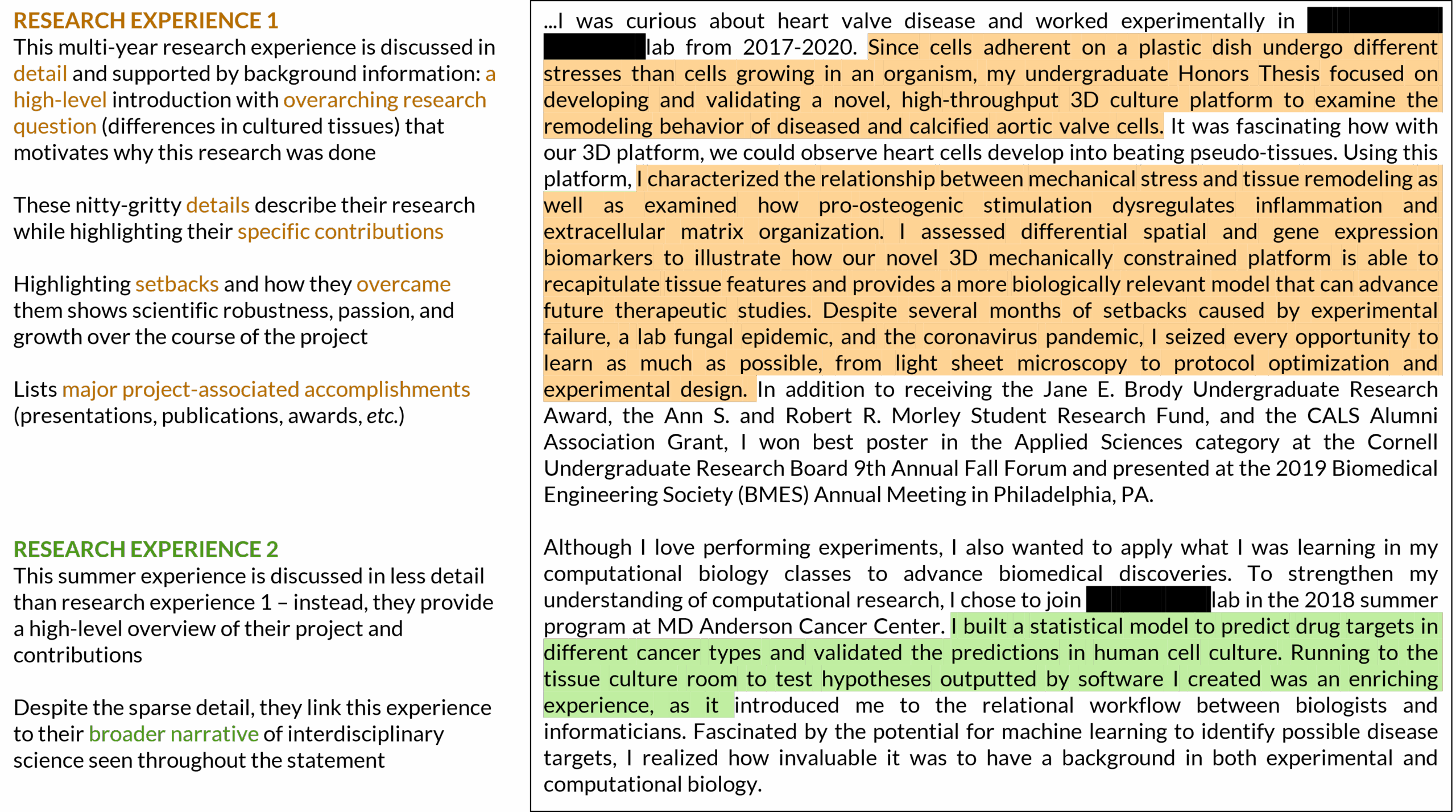
In the example below, the author describes two research experiences and goes into more details on the one that lasted longer (3 years vs a summer). Both experiences support the author’s main brand of interdisciplinary science.
Excerpt from Annotated Example 3
Demonstrate match to your target program
Demonstrate an understanding of the program to which you’re applying and about how you will be successful in that program. To do this:
- Read the program’s website. See what language they use to describe themselves, and echo that language in your essay. For example, MIT Biological Engineering’s website talks about the foundational principles and broad-reaching goals of BE.
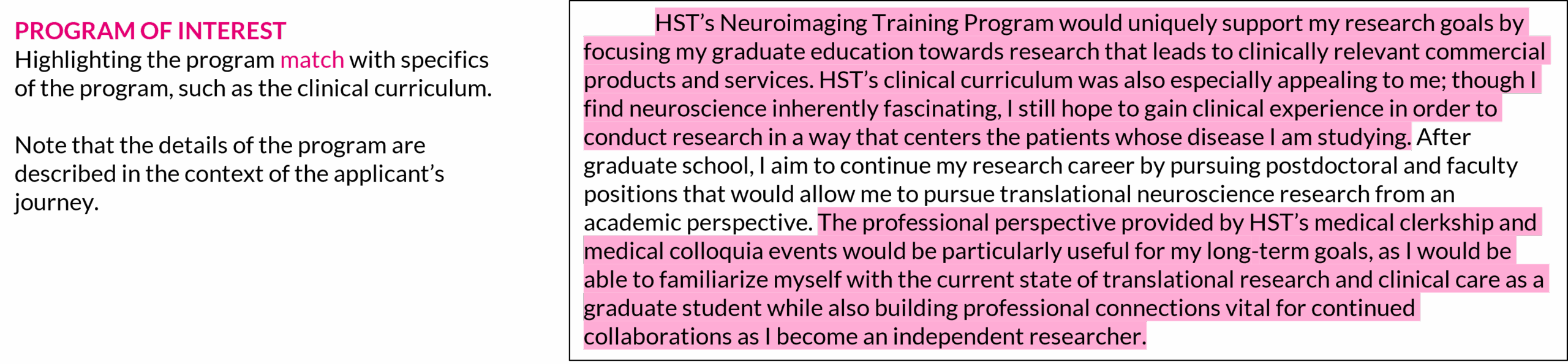
- Look for listed opportunities within the program or institution. These can include certificates, training programs, courses, student groups, partnerships with other institutes, and others. You may refer to these opportunities as you describe the match between the program and your interests and goals for graduate school.
- Get in contact with faculty or students in your target program. If you have had a positive discussion with someone at the department, describe how those interactions made you think that you and the department may be well-matched. Don’t be discouraged if you don’t get a reply; it isn’t anything personal, they may be busy or have a rule for themselves to not reply to inquiring students (this is sometimes written on the faculty’s lab website). Continue reaching out to other people in the program.
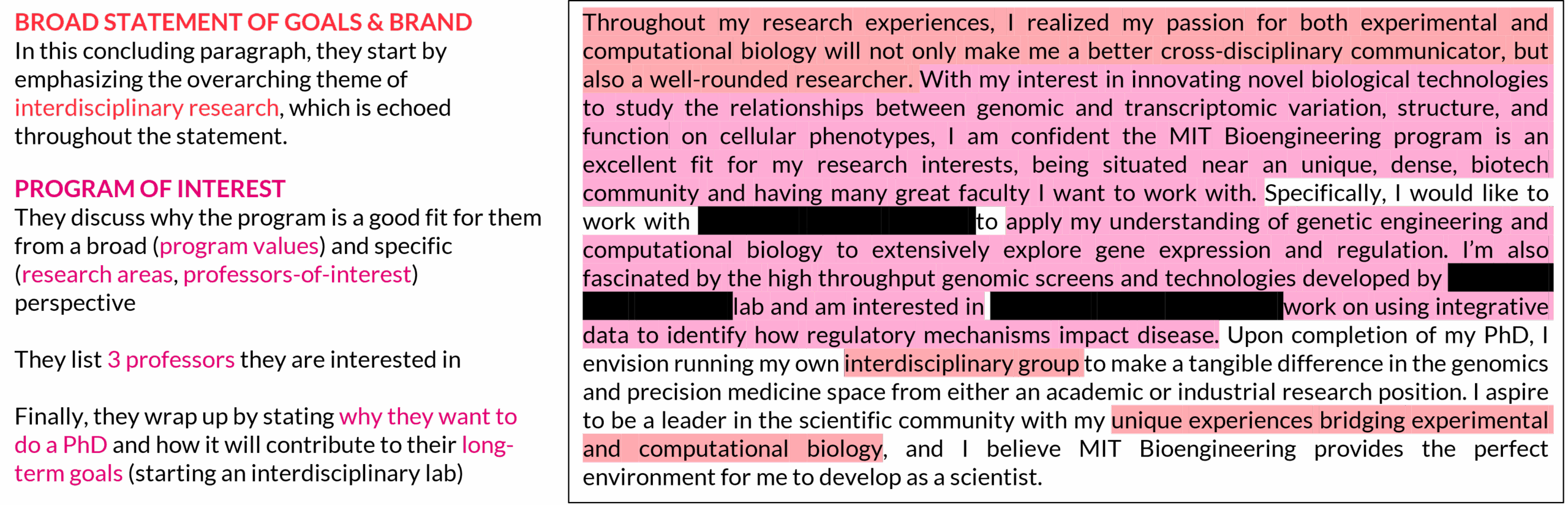
- State which professors in the program you would plan to work with. Show how their research areas align with your background and your goals. You can even describe potential research directions or projects. (Note that the expectations for this section may vary from program to program: programs where students rotate in several labs typically expect you to list 2-3 faculty, while programs where you are directly admitted to a lab may expect details on potential projects.)
Below is an annotated example of a successful application to MIT BE. This excerpt is from the last paragraph of the SOP.
Excerpt from Annotated Example 3
Here is another example from an application to the Harvard-MIT Program in Health Science and Technology (HST).
Excerpt from Annotated Example 4
You can find the full annotated examples of all the excerpts at the end of this article.
Last updated in Nov 2025
Resources and Annotated Examples
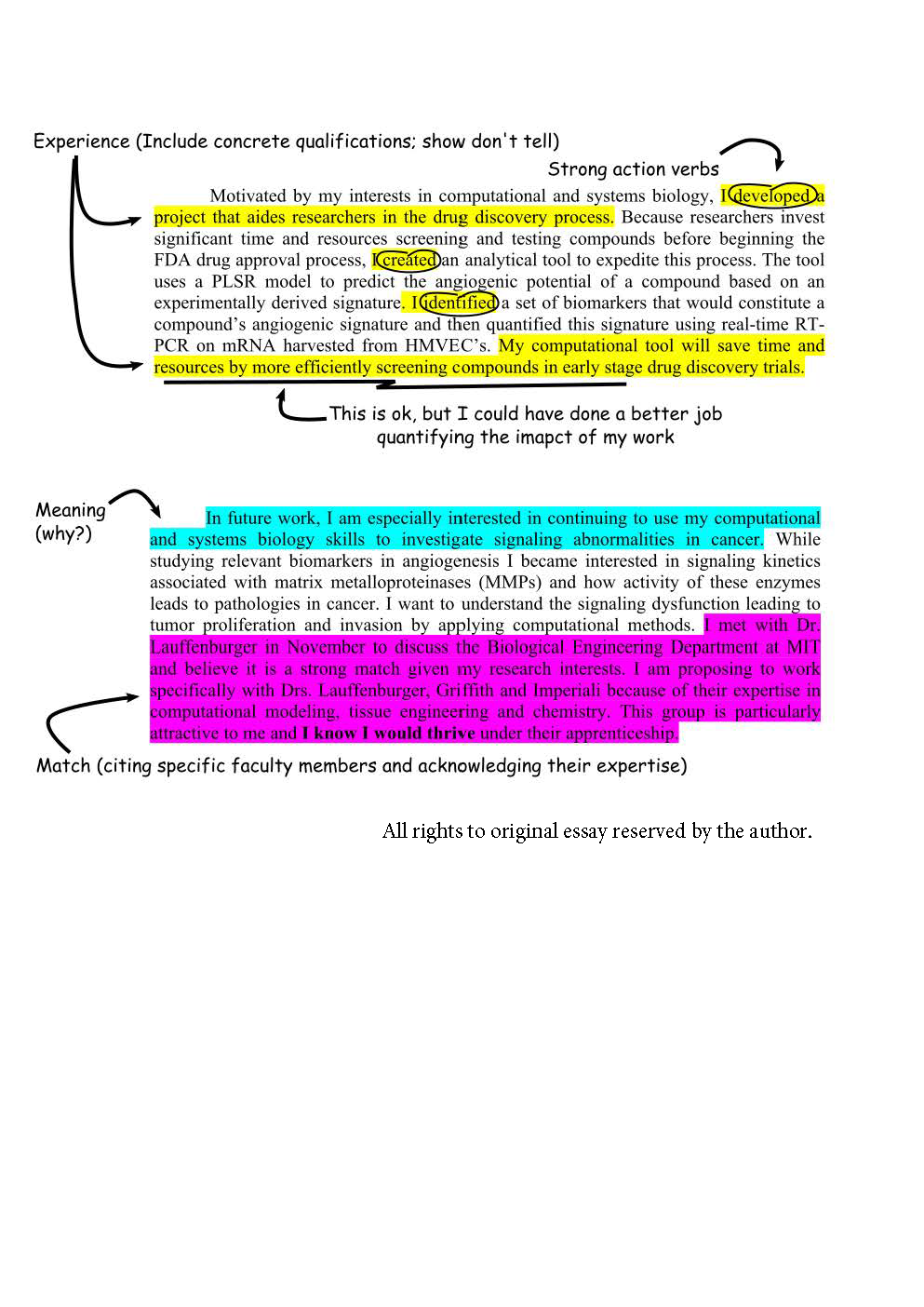
Annotated Example 1
These are selected sections from the personal statement that an MIT BE graduate student wrote in their successful application to MIT BE. 675 KB
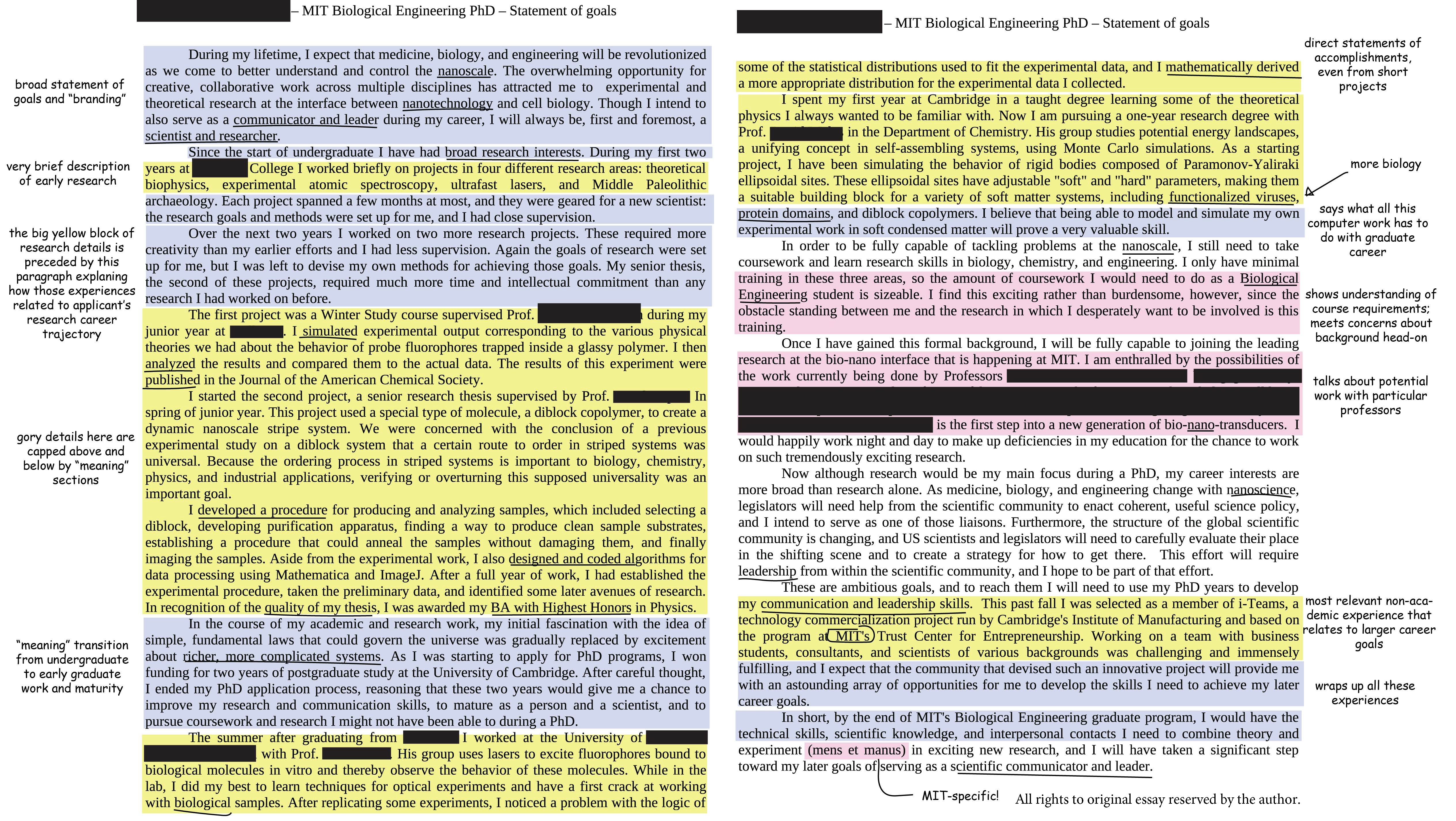
Annotated Example 2
This is the SOP from an MIT BE graduate student’s successful application to the MIT BE program. 11 MB

Annotated Example 3
This is the SOP from an MIT BE graduate student’s successful application to the MIT BE program. 2 MB
Annotated Example 4
This is the SOP written by an MIT undergraduate student for the Harvard-MIT HST program 2 MB
Annotated Example 5
This is the SOP written by an MIT undergraduate student for the Harvard BBS program 2 MB