
1. Introduction
After beginning the PhD and forming your committee, the next step for AeroAstro PhD students is to write and defend a PhD thesis proposal. The PhD thesis proposal is a plan that you present to your committee that outlines the set of problems you will address and high level ideas for the solutions that will be introduced by your PhD thesis. It should also include a sufficient literature review to demonstrate your understanding of the field and to contextualize the problems and solutions you present. The proposal consists of a written document and a proposal defense session including an oral presentation and Q&A. Critically, the nature of your proposal should balance ambition and feasibility; there should be an appropriate level of difficulty to be worthy of a PhD, but not so difficult that it would take more than a few years to achieve what you propose. Finding such a balance is one of the primary challenges of PhD research and it is best to communicate ideas with your advisor early and often. This CommKit outlines the key requirements and considerations that comprise a successful PhD thesis proposal/proposal defense, but we strongly recommend that students also thoroughly read Section 7 of the AeroAstro Doctoral Handbook as they plan their proposal.
2. Criteria for Success
- The problem statement is clear, well-motivated, and non-trivial.
- The proposal demonstrates understanding of prior work and how your plan will extend it.
- The proposal includes a realistic timeline of planned milestones.
- The proposal is well-written and tailored to your committee.
3. Audience
The thesis proposal is a unique piece of writing in that it is intended for a very small audience. It should be tailor-made for your committee (typically 3-4 members) and your external evaluator (see the graduate student handbook for more information on this). Writing something for 4-5 people allows you to construct a very focused message that will appeal to your audience. From a technical perspective, this allows you to consider the technical background of each of your audience members to deliver the appropriate level of background information to contextualize your plan. You should also consider how familiar your audience is with your department’s expectations—audience members from different departments or universities may be used to thesis proposals that are formatted differently, or that come earlier/later in the PhD journey.
4. Purpose
There are three main things that your thesis proposal should convince your audience of:
- You are familiar with your field of research and have identified an appropriate research gap.
- You have ideas that offer a promising place to begin solving your proposed problems.
- You have considered the resources (e.g., datasets, facilities, hardware), and timeline required for you to graduate with a PhD within a specified time frame.
Successfully completing these goals takes considerable preparation. Be sure to stay up-to-date on the literature of your field and take time to brainstorm ways in which you can make an impact. Also keep in mind that the work put into the proposal defense will make your path easier going forward. Not only does a strong thesis proposal defense give you a good initial direction from which to launch your PhD research, but it is also an opportunity to hear ideas from other experts in your field. While it is important to convince your committee of the points above, the thesis proposal defense is also a great time to collaboratively discuss your ideas during the feedback session. Your committee is a resource that should be relied on throughout your PhD for feedback and guidance, and the PhD thesis proposal is a pivotal point during which you should leverage their experience.
5. Structure Diagram
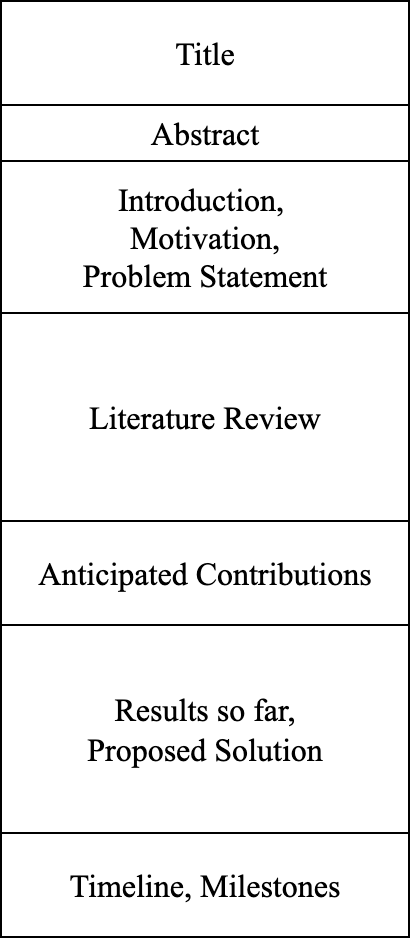
Figure 1. Structure of the written PhD thesis proposal
Fig. 1 shows the structure of the written proposal, which is limited to 10 pages as of September 1st, 2025. As stated in the PhD Handbook, the written proposal should be comprised of the following elements:
- Title page that includes the proposed thesis title [1 page].
- Abstract with 100–200 word summary of the proposed problem and contributions
- Introduction, including motivation for the research and a clear statement of the problem [1–1.5 pages]
- A thorough background section and literature review highlighting current limitations in the field [1.5–2 pages].
- Objectives of your thesis and the anticipated contributions of the research [0.5–1 page]
- Summary of the results you have gotten prior to writing the proposal (if available) and details on the proposed solution approach for future work [1.5–2 pages]
- Timeline outlining your planned research schedule, major milestones, and a list of any facilities required and how you will access them [0.5–1 page].
- A bibliography of all cited references should be provided, but is not included in the 10 page limit.
Fig. 2 shows a timeline of the typical thesis proposal/proposal defense process, which typically begins three semesters after you finish the Doctoral Qualification Process. Once you set the date for your proposal defense, you have a deadline two weeks in advance when the written proposal is due. At that time, you should send your written proposal to (1) your committee members, (2) Graduate Student Services, and (3) your external evaluator. Two weeks later, during your thesis proposal defense (which should be scheduled for a time when your committee members and external evaluator are available), you will leave the room after starting the meeting. Your committee, external evaluator, and a department representative appointed by graduate student services (who may be one of your committee members) will discuss the merits of your written proposal. Afterwards they will invite you back, and if they found the written proposal to be satisfactory, you will begin the presentation section, which is followed by an extensive Q&A section, followed finally by more discussion for which you are not present. They will then inform you of the result.
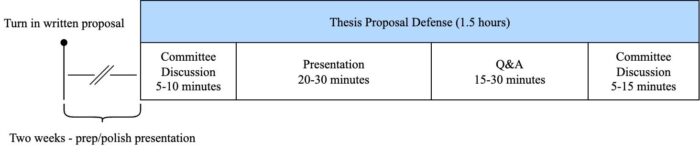
Figure 2. Timeline of the PhD thesis proposal defense.
6. Context
As stated in the PhD handbook, your PhD proposal defense should be scheduled no more than three semesters after you finish the quals process and are officially admitted into the PhD program. During those semesters, you may or may not have gotten results that can be used in your thesis. In the event that you do have results, they can be incorporated into your discussion on proposed contributions. This will allow your committee members to evaluate your work in the context of a PhD thesis and let you know if there are any gaps or other experiments that they would like to see. If your work so far will likely not appear in your thesis, it may still be worth presenting to help your committee understand what you have worked on so far. The important thing to remember in this case is that presenting on prior work does not connect directly to the goals or purpose of the proposal. If it connects well to your thesis you can use it to advertise your understanding of the field, but if the connection to your thesis work is weak it is best to briefly discuss it simply as part of your background.
7. Best Practices
7.1. Preparation
If possible, it is good to have a committee meeting (e.g., your first committee meeting) to present a rough outline of your PhD proposal to your committee. This way during the actual proposal, nothing comes as a surprise to them and you already know that you are moving in the right direction.
7.2. Written Proposal
7.2.1. Conciseness
The short length of the written proposal requirement offers a unique challenge given what it needs to accomplish. In the final product, each sentence/paragraph should have a clear purpose. Luckily, many of the required elements can be used to support each other. For example, it is natural to use key papers cited and discussed in the literature review to support your proposed approach and give your committee confidence that your ideas have a strong technical basis.
7.2.2. Planned Contributions
Given its placement in the broader timeline of the PhD program, most people will not have more than one of their contributions completed by the time they are writing their proposal. Thus, one of the unique challenges about the PhD proposal is writing about planned contributions and methods to achieve them. Brainstorming these ideas can take considerable time, during which you should try your best to discuss with peers and your advisor to get feedback and make adjustments. During this process, it pays to be as specific as possible; what are the potential step-by-step approaches you will use to get your desired contributions?
Writing about these contributions and methods raises another challenge because you may not know exactly how to accomplish them, but still need to convey that they are feasible. Citing previous work, (both from yourself and other relevant work), is a good way to point to similar ideas, then explain how you plan to modify/extend them to address your problem statement. Specifically highlighting relevant equations/techniques and discussing how they may be useful is also a good strategy that will give your committee the feeling that you are looking in the right direction. You should also give an indication about the expected results: what are the expected characteristics of your solution, and what experiments will you showcase to highlight them?
7.2.3. Timeline
The timeline is an important piece of the proposal as it indicates to your committee that you have a feasible plan to execute your proposed contributions within a finite time horizon (it’s not just something you will finish someday). Elements of the timeline could include when you plan to start/finish each contribution and/or when you would like to submit related papers and to where. Consider the magnitude of each contribution and give it a period of time in which it can reasonably be accomplished. Given the nature of your research, you may be able to overlap some components of your timeline (consider the case where a long-term experiment needs to be run but does not take too much work once it is set up). While specifying your timeline, you should also specify the expected deliverables for each contribution. Indicate if you intend to submit a journal/conference paper and one or two potential venues that you might submit to.
7.3. Proposal Defense Presentation
7.3.1. Purpose
The proposal defense is a unique presentation because everyone in your audience will have (at least supposedly) read your written proposal document. The purpose of your presentation is thus less to introduce the audience to your ideas, and more to demonstrate that you are comfortable with the material and to lead to constructive interactions with your committee during the Q&A. Given this subtle point, you may wish to spend a little less time reviewing existing literature when compared with your written proposal. For example, instead of discussing every paper you cited, you might use just a few slides to visually summarize the state of the art, then devote the rest to your proposed contributions, which will be the primary topic of discussion during the Q&A.
7.3.2. Location
If your committee consists entirely of local members, you may be able to present your proposal defense in person. However, it is more common that one or more of your committee members will need to attend virtually. In either case, be sure to prepare a space in which you can present the oral portion of the defense. The proposal defense has a unique factor in this regard due to the committee-only discussion sections. In the event that you are presenting in a purely virtual format, it is recommended to angle your camera so that your committee can see you leave the room. They should then message you when it is time to come back in. Regardless of format, it is important to reserve a space that will facilitate your proposal defense.
7.4. Other Resources
- The Doctoral Handbook: While the advice presented in this CommKit is accurate at the time of its writing, the exact specifications for the PhD thesis proposal are presented in Section 7 of the AeroAstro PhD Handbook. Be sure to check there to keep up-to-date with the latest requirements and become familiar with details not discussed here.
- Use other CommKits: There are many components of the PhD proposal/proposal defense, so we have not been able to discuss all of them in depth here. Luckily, there are CommKits available that address many of these components. Our work on Formulating a Research Topic, Abstracts, Figure Design, Slide Design, and Physicality of Presentations may be particularly helpful.
Resources and Annotated Examples

PhD Proposal Example: Note, this example predates that new standardized format.
Annotated PhD Proposal 1 MB