This CommKit article focuses on the two main components of the MIT CEE Doctoral Research Proposal: 1) the written document, and 2) the oral presentation. While the information largely references proposal requirements from the MIT CEE Doctoral Program Guide (which should be your first read as a CEE PhD student!), the general ideas presented here should be applicable across different research areas and disciplines, and are informed by examples from thesis proposals as well as insights from faculty.
Criteria for Success
- Read the proposal guidelines in the MIT CEE Doctoral Program Guide.
- Seek guidance/feedback early and often on your proposal ideas from your advisor!
- A strong motivation and clear identification of research gaps in your field will bring your proposal together.
- Clearly state your overarching research question.
- Focus on defending your proposed methodology, not necessarily any results!
Understanding the purpose of the proposal
The PhD proposal is a blueprint for your research. It should present a research question situated within existing literature in your field and outline a clear plan to answer your question. However, you are not answering the question in your proposal, rather you are:
- Defining a clear and relevant research question or problem
- Justifying a need for this research in your field
- Outlining your approach and methodology to solve this problem
- Demonstrating feasibility within your PhD timeline and available resources
Just as importantly, the proposal should serve as a communication tool to convince readers (your advisor and committee members) that your project is not only important to your field, but that the research scope, methods, and resources are manageable and methodologically sound.
Knowing your audience
Your readers will be your thesis committee members, composed of your advisor and other faculty or senior research staff. While they will bring the expertise needed to evaluate your work, it is important (and good practice) to frame your proposal in a compelling way for a general scientific audience. Avoid too much technical jargon and be sure to define all acronyms! You are allowed to request one review of one draft from your advisor–take advantage of this!
Getting advisor input
Starting the proposal can seem like a daunting task. Besides reading the MIT CEE Doctoral Program Guide, seeking feedback from your advisor well before a draft is written is important and recommended. This feedback should be regarding any ideas you might have for your doctoral research and how you might need to include any current projects or pre-proposal work you may have already done. In fact, the MIT CEE Doctoral Program Guide explicitly writes “The objectives of the research should be prepared with guidance from the advisor. Because most doctoral research is funded by projects developed by the advisor, it may need to meet specific benchmarks.” It might be helpful to send an initial email with thoughts and request to schedule a special meeting with your advisor just to focus on your proposal, separate from your regular meeting check-ins.
Writing the proposal
The MIT CEE Doctoral Program Guide lists specific requirements for the proposal:
In addition, the guide requires the following sections to be included: Abstract, Introduction, Objectives/Hypotheses, and Proposed Research.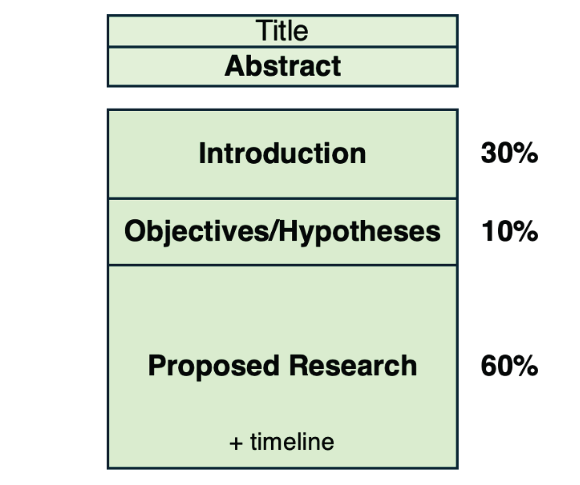
Tip: Try to spend about 30% on the introduction and 70% on your research plan. Remember: your thesis proposal should be mainly about your proposed research. As one CEE faculty member shared, “A common pitfall is students will often overinvest in the Introduction, leaving little detail on proposed methodologies.”
Title
Though not explicitly stated in the doctoral program guide, crafting an informative title sets the tone for your proposal. Oftentimes, this can evolve into your final doctoral thesis title. Avoid vague and generic titles that do not give context to your thesis. A strong title should be descriptive, but not too lengthy, and incorporate searchable keywords to interest future readers.
Tip: Stuck on a title? You might find inspiration from scanning titles of journal articles within your field and revise them as they might have appeared in a proposal.
Abstract

The Abstract should be a concise summary of your proposed research: what you propose, why it matters, and how you will do it. For specific guidance on writing an effective Abstract, check out our Abstract Commkit article, which includes examples and an Abstract Generator worksheet.
Tip: It might be more helpful to write the abstract after the main text of your proposal is written!
Introducing the problem

The introduction lays the foundation for your proposal. The purpose is to pitch and motivate your research within your field and for a broader engineering or societal context. Aim for a narrative arc that moves from the general problem to your specific research objectives. The following structure is one way to outline your Introduction:
1. Frame the high-level problem
Begin by framing the broader problem your research addresses. Explain the current challenge or need in the field and introduce your topic in a way that makes its importance immediately clear to the reader. When possible, quantify the scale or consequences of this challenge, such as its frequency, cost, or the number of people, systems, or environments affected. This section should help the audience understand why the problem matters before you narrow to the specific gap your project will address. Here are a few prompts with examples to help you develop your own outline.

*Don’t forget to keep track of sources while you are writing and researching! While an initial outline can prioritize getting ideas and arguments onto the page, citations should be added and verified as your draft
2. Narrow your focus
After introducing the broader problem, narrow to the specific system, mechanism, or phenomenon your project examines. Provide only the background needed for the reader to understand the key concepts, terms, and relationships relevant to your research question. If the problem involves several interacting parts, a conceptual diagram or schematic can help clarify how the system works and where your study fits.
Example sentence structures to introduce the focus:
- This proposal focuses on [specific system or process] as a key part of the broader problem.
- The central phenomenon of interest is [phenomenon], which connects [factor A] and [factor B].
- In this context, [term] refers to [definition], an important concept for understanding [problem].
- The conceptual diagram in Figure # helps show how [variables or processes] interact and how my proposed research is focused on these relationships.
Fig. 1 is an example of a conceptual figure from Gleeson et al., 2026. This figure is an effective conceptual figure because it organizes a complex topic into a simple visual framework, using two clear axes to compare natural hazards by warning potential and impact on water supply. The figure helps readers understand the authors’ conceptual framing and why different hazards pose different challenges for water-resource planning in a way that is more visual and intuitive than text alone.
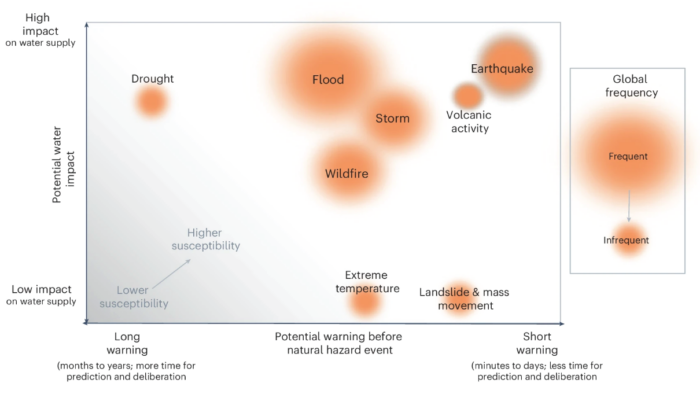
Figure 1. Example of a conceptual classification figure from a published journal article. Original caption: “Fig. 1: Classification of natural hazards on the basis of the potential for warning before the natural hazard and the potential for impact on water supply. Each hazard is scaled by the global frequency of each type of natural hazard and positioned along the relative scale of the axes on the basis of the expert knowledge of the coauthors. The size and location of ‘drought’ on this graph does not consider flash droughts.” Image from Gleeson et al. (2026).
3. Review the literature and knowledge gaps
The literature review is a critical component of your introduction. It should not just reference previous studies or be a summary of past work in the field, but also:
- identify gaps in current research,
- demonstrate where your proposed project stands in relation to current research, and
- set up the rationale for your specific research objectives.
The studies you choose should trace the evolution of ideas leading up to your work. What has been done, both historically and in recent advancements? What was found? Where are the present-day limitations? How do these studies relate to your project? It is important to draw connections among these studies to show the current state of knowledge and articulate what remains unresolved or where knowledge is still limited.
Tip: you should cite the articles you reference in your literature review and throughout your thesis proposal using a citation style from a journal that is well-known in your field.
The excerpt below was taken directly from the ending of a Literature Review section in a CEE thesis proposal. Since this is the conclusion that reiterates the main takeaways, the evidence to support these claims was provided earlier in the Literature Review section with appropriate citations.
“Taken together, the current literature reveals that numerical models often produce divergent predictions of short-term climate responses due to contrasting parameterizations, resolution limitations, and boundary‐condition assumptions. Yet efforts to benchmark these simulations with real‐world data have been sparse; most observational campaigns have been limited in duration, vertical coverage, or sampling frequency, making it difficult to assess when and why models disagree. Without comprehensive high‐resolution measurements of atmospheric state variables, we lack the empirical references required to rigorously evaluate model performance and diagnose the schemes that drive their inconsistencies. Accordingly, this proposal prioritizes an observationally driven approach to fill this critical gap and establish a robust foundation for improving model fidelity in simulating extreme events.”
4. State your research aims
A clear and focused statement of your research aims transforms your background and literature review into a concrete plan with explicit goals.
The Big Question: What you want to know, framed as a single, concise scientific question. Center it on the key gap you identified in your literature review. You should aim to write a question that is novel, unanswered, and challenges prevailing assumptions, while avoiding overly broad or purely descriptive phrasing. Ultimately, your research will attempt to answer, or at least better understand, this central question. Here is an example research question sentence structure:
- How does [key factor] influence [outcomes] under [conditions]? A secondary question might be: When is this effect strongest/weakest and why?
5. Highlight impact
In the Introduction, keep the impact section short and concrete (about 2–3 sentences). State your scientific contribution, then name one or two application areas it could inform. If practical use is still far off given the scope of your proposed thesis work, you can describe a pathway rather than a promise (e.g., reducing uncertainty, improving a model component, or identifying when an assumption in practice might fail from theory).
Example sentence structures to state potential impact:
- This work will advance understanding of [process] by quantifying [mechanism/sensitivity] using [approach/data].
- These results can inform [application area] by improving [model/metric/constraint], supporting better [prediction/management].
- Given long-term operational use, an immediate implication is [reduced uncertainty/clearer failure modes], which enables future [model development/decision tools].
6. Roadmap your proposal (the final paragraph!)
It is good practice to end the introduction with a preview of the next sections so readers know what to expect: Objectives/Hypotheses, Proposed Research, Timeline. The excerpt below was taken directly from the ending of the Introduction section of a CEE thesis proposal.
“The sections that follow introduce and discuss more details on the background for each pathway and propose a thesis chapter, highlighting research objectives with corresponding hypotheses and a detailed approach outlining the methods applied to achieve the objectives of the chapter. A timeline for completion is included at the end of the proposal.”
Forming your objectives/hypotheses

This section bridges the gap you identified in your Introduction and lays out the precise aims of your project. It consists of three parts: your central research Question, corresponding Hypotheses, and a set of supporting Objectives. You can choose to format these components in the proposal on their own lines or integrate them within a paragraph.
1. The Big Question: You should clearly restate your primary research question. Add any secondary or follow-up questions that clarify scope (scale, conditions, population, time) and directly connect to the objectives.
2. Hypotheses: Expand on your questions by providing directional expectations for your future work. What do you anticipate as outcomes to your questions, and why? What are the implications if your hypothesis is correct?
Here is an example sentence structure to state a hypothesis:
- It is hypothesized that the [parameter], measured by [metric], will [increase/decrease] [outcome] by [threshold] under [condition].
3. Objectives: Translate your main research question and secondary questions into concrete, measurable goals and should be ordered logically according to your research plan. This can be a good place to concisely explain how you will tackle your question (e.g., modeling, data collection, fieldwork, experiments, etc.) or highlight a specific method, data/source, analysis, an output, or metric.
Here are example objective statements from a thesis proposal:
- “Objective 1. Provide a comprehensive review of literature and industry practices in relation to sustainable construction methodologies and outline a conceptual framework for integrating green building strategies into project delivery.”
- “Objective 3. Compare existing model representations under different scenarios and evaluate against observational results.”
Tackling each of your objectives will be a significant project. In turn, you can also think of the outcomes of these objectives as the separate papers that might be produced during your doctoral research.
Proposing your research methodology

In this section, you should address the methodology for completing each objective in detail. Use this section to prove you have a plan that will work: methods that directly address and answer your question(s), a timeline that is manageable for a PhD, and expected results that will contribute scientifically and/or societally. You can format this section in your proposal by starting each section with the research objective as a heading and then including the components below within the narrative.
Fig. 2 demonstrates examples of components to include within each methodology section:
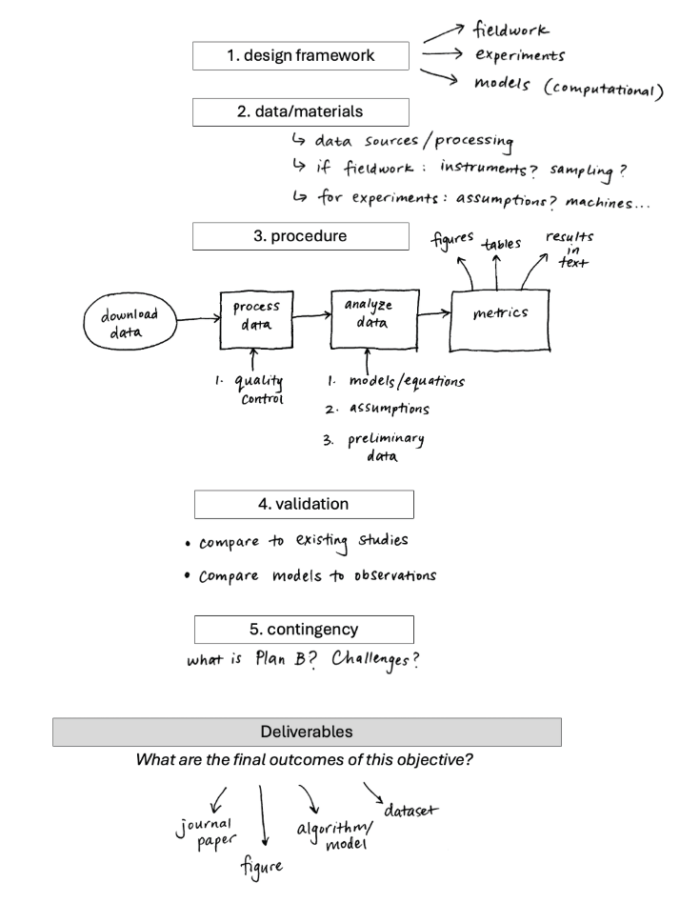
Figure 2. Handwritten annotations on content to include in each section for the proposed methodology for an example project. The categories of potential content are included beside each main methodology section of a thesis proposal.
Methodology FAQs
What if I do not know the exact method yet? Anchor your proposed approach with the central question, and think about the outcomes/metrics you will measure. What do you know so far? It can be helpful to inventory what you already have: data sources, data processing, existing models/simulations/code, fundamental equations, instrumentation/tools, experimental setups, etc. If relevant, you can consider existing methods that you have read about in previous journal articles. These are all details that can be included in your approach, and be sure to reference studies that motivate an existing method if you are following a similar methodology. It may also be helpful to discuss your proposed methodology with your advisor ahead of time.
Should I include any results? Your proposal should not focus on actual results or answers to your proposed question, though the guide does ask you to “describe specific expected results.” Therefore, it can be beneficial to show some preliminary results to prove your methods can be successful. For example, if you have already done some data processing and analysis, it may be appropriate to show an exploratory figure or table. If you do not have preliminary data, you can still describe the data you anticipate generating, and share the reasoning behind these expected results, such as reported trends in the literature.
Tip: A picture is worth a thousand words! Support your proposed methodologies with high-level conceptual figures (existing with citation or an original that you have made) such as in Fig. 1 above and/or preliminary results. Below (Fig. 3) is an example of a preliminary result. This figure is a useful example because it demonstrates progress in building the analysis workflow and confirms that the data capture expected atmospheric structure, such as the vertical temperature and humidity gradient and changes through one day. A preliminary result does not need to be a final scientific conclusion! In a thesis proposal, it can show that the student has successfully accessed, processed, quality-controlled, and visualized a relevant dataset.

Figure 3. Example of a preliminary result from data processing. Original caption: “Vertical structure and diurnal evolution of temperature (top) and specific humidity (bottom) from the surface through the atmosphere from processed data on 06/01/2021, derived from ARM Tropospheric Optimal Estimation Retrieval (Turner, 2010). This plot demonstrates that the raw profile data has been processed into a physically interpretable format.” Preliminary figure using data from Zhang et al. (2025)
Timeline
Use your timeline to prove feasibility and expected completion times for your project milestones. The timeline should not be a task list; aim for a concise, milestone-based timeline. If you are unsure about how to estimate specific aspects of your proposed work, consult your advisor and/or labmates who have conducted similar research.

Figure 4. This timeline table is a modified version from the Timeline section of a CEE thesis proposal.
The oral presentation
The MIT CEE Doctoral Program Guide specifies that the oral presentation should be “45 minutes, followed by 45 minutes of questions”. These questions are not necessarily a critique of the proposed work, but rather an opportunity for you to defend and strengthen your methodology. Be prepared to show your understanding of the topic and justify your approaches (preliminary results can be helpful here!).
The thesis proposal presentation differs slightly from the written thesis proposal in that it should show more of a story with discussion of preliminary results (defending the feasibility of your proposed ideas and methods), rather than a strict regurgitation of the information in the proposal document. For example, rather than delve into the literature at length, you may wish to focus more of the presentation on the methods you plan to employ. You can also think of this meeting as the first Committee Meeting towards defending your dissertation!
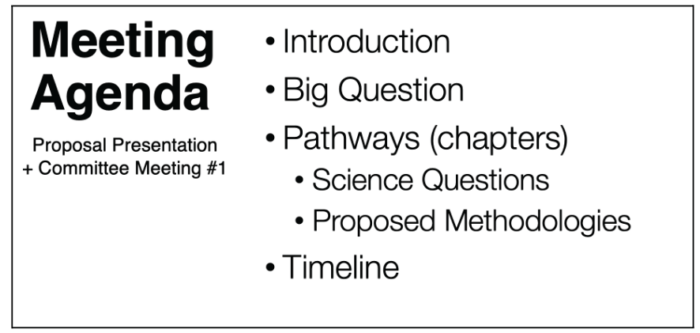
Tip: Set the tone of the meeting with an agenda. Beyond a defense of your proposal, the oral presentation also serves as your first committee meeting. An agenda provides structure for the meeting, establishes an appropriate time for questions, and demonstrates your professionalism and preparedness. Your thesis committee should have read the proposal beforehand, but it is good practice in general to go over all proposal content as if it were their first time, re-clarify expectations throughout, and answer any outstanding questions that may arise. Here is an example slide from the Introduction of a CEE thesis proposal presentation:
You can field questions on your presentation by setting expectations during the meeting. Be prepared to support questions about the contributions from your research and how your work is novel to the field. While the Q&A experience can feel intimidating, the questions are not necessarily motivated by skepticism regarding your approach! Rather, Q&A is a good time to engage in dialogue with your audience, and take advantage of the feedback that the committee may give you to improve your research.
Concluding thoughts
A strong proposal paper and presentation does three things well: 1) asks a clear question, 2) outlines a feasible plan, and 3) demonstrates why the answer to your question is important. However, it is also important to remember that the proposal is a roadmap, not a contract. Changes in research are common, and even expected, throughout the course of your PhD and research career. Good luck on this important milestone!
If you are an MIT student in need of support with your PhD proposal process, you can schedule a Comm Lab appointment. We will work through it together!
Resources
- MIT CEE Doctoral Program Guide
- Your advisor!
- Experienced peers, including Comm Fellows, who have gone through the process.
- CEE CommKit Articles
- MIT CEE theses on DSpace
Works Cited
Gleeson, T., T. Endo, M. Taniguchi, et al., 2026: Natural hazard susceptibilities and inequities reduced by short-term groundwater use. Nature Geoscience, 19, 12–18, doi.org/10.1038/s41561-025-01884-0.
Turner, D. D. (2010). Tropospheric optimal estimation retrieval (TROPOE), 2015-12-31 to 2024-12-31, Southern Great Plains (SGP) Central Facility, Lamont, OK (C1). ARM Data Center. Accessed 2025-10-03 [Dataset]. dx.doi.org/10.5439/1996977.
Zhang, M. S., Turner, D. D., & Entekhabi, D. (2025). Relative contributions of surface parcel and atmospheric environment to convective potential during interstorm periods. Journal of Hydrometeorology, 26, 1395-1406. doi.org/10.1175/JHM-D-25-0045.1